How should a label application position be chosen?

Choose a flat, supported and repeatable area that the applicator can reach while the pack is controlled. The finished label must remain visible and undamaged after wrapping, conveying and handling, and any barcode must retain the required quiet zones, orientation and line of sight for the downstream scanning process.

Direct answer

What this means for a real production line

A viable application position must work mechanically and remain useful to downstream scanners and handlers. Show the preferred and acceptable placement windows on a dimensioned pack drawing, then prove them with minimum and maximum packs and the final wrapping or handling sequence.

  • Mark the preferred and acceptable label-placement window.
  • Show the scanner approach and every downstream obstruction.
  • Prove worst-case pack support, variation and applicator access.
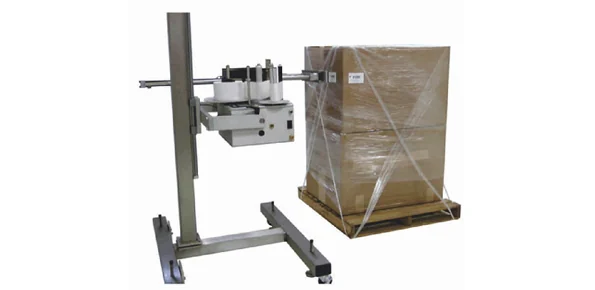
Pallet and case labeller showing application position considerations
Application geometry

Compare the position against pack movement and downstream access

The easiest face for the applicator is not always the best face for scanning or later handling.

Top faceCan provide good mechanical support on stable cartons, but confirm overhead clearance, downstream contact and how the label will be scanned.
Side faceOften accessible on a conveyor when the pack is guided, but height variation, guide-rail position and product skew must be included.
Leading or trailing faceRequires controlled product timing and sufficient access without collision or interference from the next pack.
Corner wrapProvides information across two faces but requires suitable label geometry, a sound corner and controlled transition around the edge.
Pallet faceRequires the label to remain accessible after wrapping and handling, with sufficient reach and a defined short-side or long-side sequence where required.

Protect the complete barcode, not just the printed bars

Barcode placement must preserve the symbol, quiet zones and contrast after the label is applied. Avoid edges, seams, straps, wrap folds, curvature, abrasion points and surfaces that distort or shadow the symbol. Validate the finished labelled pack from the intended scanner approach.

Where GS1 identification is used, follow the current GS1 UK barcoding guidance, the GS1 Logistic Label Guideline and any customer-specific requirements. Final label compliance remains application-specific.

  • Show the proposed label boundary on a dimensioned drawing.
  • Include all normal pack-size and surface variation.
  • Confirm downstream guides, scanners, straps and wrapping.
  • Test finished packs rather than loose labels alone.

Prepare an application-position trial

Mark the preferred and acceptable placement windows on the pack, provide worst-case samples and record the scanner approach. The trial should include skewed packs, surface variation and the final wrap or handling step where these affect the label.

Pack support

Is the surface flat and stable during application?

Applicator access

Can the mechanism reach without contact risk?

Scanner access

Will the finished barcode be visible from the real read position?

Handling protection

Will guides, wrap, straps or operators damage or cover it?

Buyer questions

Common questions about this decision

These answers identify the variables that should be confirmed before a machine, label or control sequence is fixed.

Is top labelling always the easiest position?

No. A top face can be mechanically convenient, but it may conflict with overhead equipment, stacking, case sealing, downstream contact or scanner line of sight. The best position is the one that works through application, inspection and the rest of the handling journey.

How close can a label be applied to an edge?

The answer depends on label geometry, applicator method, pack quality, barcode standard and customer requirement. Leave enough supported surface for reliable application and preserve the barcode quiet zones. Where GS1 rules apply, use the current specification rather than a generic clearance.

Should a pallet label be applied before or after stretch wrapping?

Both sequences are used, but the choice changes the surface, adhesion and barcode visibility. If applied to wrap, trial the final film tension and condition. If applied before wrapping, confirm the film will not distort, obscure or reflect across the barcode.

Can one station apply labels to two faces?

It can be possible with corner-wrap, swing, multi-axis or separate application motions, depending on the pack and face relationship. The complete cycle, reach, product control and inspection requirement must include both labels or both faces.

What drawings or samples are needed to confirm label position?

Provide dimensioned pack drawings, label artwork, acceptable placement tolerance, conveyor height and direction, photos or video of guides and downstream equipment, plus representative minimum and maximum packs. Mark scanner approach and any customer-mandated position.
Need this answer applied to your line?

Send the label, pack dimensions, application position, line video, data source and required checks. Lancing UK can identify what must be confirmed before quotation.

Call nowContact us