What determines print and apply labeller speed?

Achievable print-and-apply output is limited by the slowest part of the complete cycle: product spacing, data response, label printing, label presentation, applicator travel, contact or dwell time, return motion and any verification or reject sequence. A print-engine speed alone is therefore not a dependable line-speed figure.

Direct answer

What this means for a real production line

For a real production line, the limiting step can change with the label format and pack. A speed study should use the longest expected label, the smallest normal product gap, the greatest required applicator travel and the agreed inspection sequence rather than one easy sample.

  • Measure the worst normal label-and-pack combination.
  • Include communications and verification latency in the cycle.
  • Prove sustained running and controlled recovery, not one fast cycle.
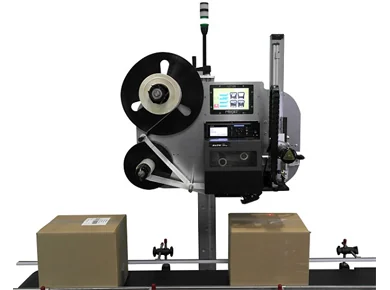
Case print and apply labeller on a conveyor
Cycle analysis

Break the cycle into measurable parts

A realistic target is built from the actual label, pack and control sequence rather than from a headline printer specification.

Product arrivalPack speed, minimum gap, skew and whether the pack can be stopped or indexed.
Data preparationTemplate selection, database or PLC response, variable-field population and validation.
PrintingLabel length in the feed direction, print resolution, amount of printed content and approved print settings.
Label presentationDispense distance, liner behaviour, vacuum build-up and whether the label is stable on the pad or wipe edge.
Application motionTravel distance, acceleration, contact or wipe distance, dwell and return to the ready position.
Inspection and releasePresence checks, barcode reading, expected-data comparison, verification and reject timing.
Recovery allowanceDefined response to no-label, no-read, communication loss, short product gap or interrupted cycle.

Print speed is not the same as labelled-pack output

The printer may complete its task before the applicator is ready, or the applicator may be waiting for the next stable product. A quoted output should therefore state the tested label dimensions, product presentation, application method, data source and inspection sequence.

  • Use the longest approved label and densest normal artwork in the trial.
  • Include the smallest normal product gap and worst normal pack variation.
  • Measure sustained operation, not a single successful cycle.
  • Include the time and line response for inspection failures.

Continuous and indexed applications behave differently

A wipe application can suit a stable moving pack, while a tamp arrangement may need a repeatable application window. Pallets may require the load to stop while the applicator reaches one or more faces. The right cycle analysis follows the actual pack motion instead of forcing every product into the same timing model.

Continuous flow

Product speed, gap, label feed and wipe geometry must stay synchronised.

Indexed flow

Stopping tolerance, dwell and restart timing become part of the cycle.

Random arrivals

Buffering or queue control may be needed to preserve the minimum gap.

Multi-label duty

Every label and face must be included in the complete pack cycle.

How to establish a defensible target

Record the operating conditions that make the result meaningful and repeatable.

Define the required sustained output

Use normal production demand and peak demand, together with realistic product gaps and planned changeovers.

Build the worst normal test set

Include the largest print job, longest label, least stable pack and any required downstream inspection.

Run a representative sequence

Test enough consecutive packs to expose queueing, timing drift, ribbon or label-roll effects and recovery from a controlled fault.

Document the conditions

Record the product, label, settings, data path and acceptance criteria so future comparisons use the same basis.

Buyer questions

Common questions about this decision

These answers identify the variables that should be confirmed before a machine, label or control sequence is fixed.

Does a smaller label always make the system faster?

A shorter print and feed distance can reduce part of the cycle, but the complete output may still be limited by product spacing, applicator travel, dwell, verification or conveyor handling. The bottleneck must be identified from the whole sequence.

Can a higher print resolution affect output?

It can affect print time depending on the print engine, label length, artwork and settings. Resolution should be selected for the smallest required text or barcode element and then tested with the actual label, rather than chosen independently of output.

Can product buffering improve labelled-pack throughput?

Buffering can protect a labelling station from irregular upstream arrivals, but it does not increase the applicator cycle itself. The buffer, release logic and minimum product gap must be designed so packs do not reach the labeller too closely together.

What happens when packs arrive too close together?

The station may not have time to print, present, apply and reset before the next pack. A controlled system should prevent an incomplete cycle by regulating the product gap, holding the next pack or generating a defined fault rather than applying an uncertain label.

How should print-and-apply speed be tested?

Use representative packs, approved labels, live or simulated production data and the required inspection sequence. Test sustained operation at the target rate, then include controlled stops, no-reads and restarts so the accepted result covers normal production and recovery.

Need this answer applied to your line?

Send the label, pack dimensions, application position, line video, data source and required checks. Lancing UK can identify what must be confirmed before quotation.

Call nowContact us