Product guides
Guides reduce lateral movement and skew, but they must not damage weak cartons or prevent normal size changeover. The guide datum should match the label-position drawing.
Reliable placement starts with a measurable label datum and controlled presentation of the pack at the applicator.
Specify label position by measuring from a repeatable pack datum, stating the allowed placement tolerance and showing the complete label footprint on the minimum and maximum pack. Product guides, sensors and conveyor control must then present the pack so the applicator sees the expected face at the expected distance and the barcode remains visible to the intended scanner.
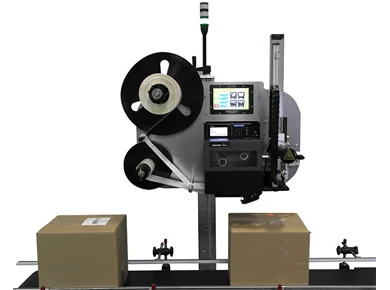
| Top application | Useful when the upper surface is consistently accessible and the pack height is controlled or measured. Avoid unsupported lids, open flaps and unstable contents. |
|---|---|
| Side application | Works well on guided cartons and totes with a stable side face. Product width and lateral position determine applicator distance and scanner view. |
| Front or leading-face application | Requires accurate product timing and a clear face before the pack enters the station. Accumulation and close product gaps need careful review. |
| Corner wrap | Places one label across two adjacent faces. The corner geometry, label material, adhesive and wrap motion must be proven together. |
| Pallet face | Requires the load face, wrap condition, overhang, label height and one-, two- or three-side sequence to be defined with the warehouse scanning requirement. |
Guides reduce lateral movement and skew, but they must not damage weak cartons or prevent normal size changeover. The guide datum should match the label-position drawing.
The product trigger must detect a consistent feature early enough for data, printing and applicator timing. Transparent film, dark surfaces and openings may require a different sensing method.
Variable speed, slips, acceleration and accumulation change timing. Use the line's real speed reference and test restart conditions rather than relying only on a static delay.
A changing top or side face can alter applicator travel and label contact. Mechanical adjustment, recipe control or automatic measurement may be required depending on the variation.
Soft bags, loose film and partly filled cartons can move during contact. Wipe direction, tamp pressure, product support or a non-contact method may need to be considered.
The applied barcode needs a clear, repeatable view at the scanning point. Straps, stretch film, reflections, adjacent labels and conveyor hardware can obstruct the field of view.
It can be possible, but the seam may move, step or open and can reduce contact area. If the seam is unavoidable, use the final carton construction and include damaged, bowed and loosely closed cases in the trial.
Yes when product speed, orientation, gap and guide position are controlled and the selected applicator matches the motion. Placement should be measured across the full pack range and normal speed variation.
Small controlled differences may be covered by applicator travel or recipe adjustment. Larger or unpredictable variation can require height measurement, a longer stroke or a different application face.
The line must either orient the carton before labelling, identify the orientation and select a valid motion, or reject uncontrolled presentation. A fixed applicator cannot place the label on a face that is not consistently available.
The answer depends on label artwork, barcode quiet zones, pack geometry, scanner position and the likelihood of edge damage or wrap distortion. Use the approved label and confirm placement with the intended reader or verifier.
The gap must allow the previous application and return to finish before the next trigger. It also affects scanner exposure, reject timing and the ability to keep a failed pack separate from normal flow.
Include the final label, pack dimensions, desired face, datum measurements, conveyor height and a video of the real product flow.