Real-time print & apply
Integrated print engine and applicator place freshly printed labels in one controlled process.
Industrial label printer-applicators that print variable data in real time and apply labels directly onto cartons, cases, pallets or products in motion.
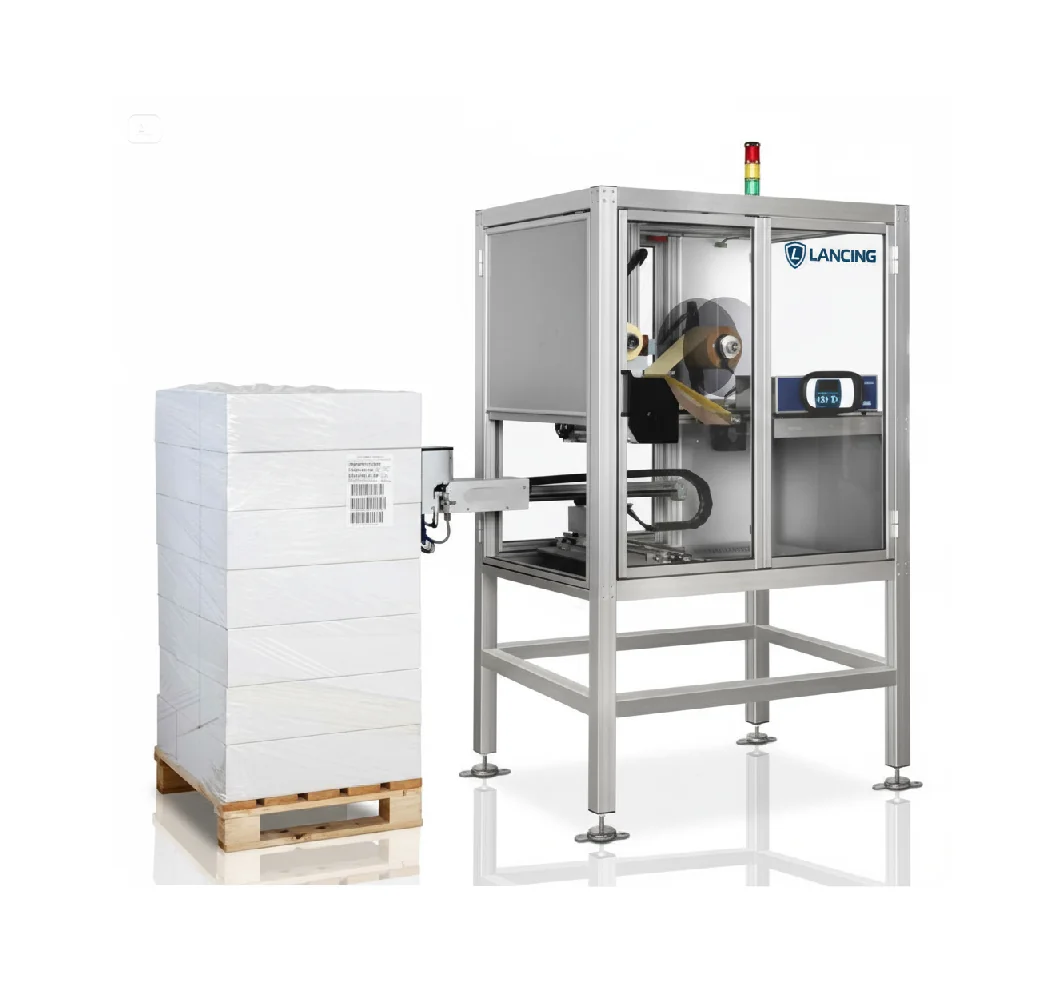
Configured around your label, pack format, line speed and data requirements.
Integrated print engine and applicator place freshly printed labels in one controlled process.
300 or 600 dpi options for crisp barcodes, text, graphics and compliance labels.
Print speed up to approximately 600 mm/s depending on resolution, label size and media.
Tamp, wipe, blow or corner-wrap modules can be configured for front, side, top and two-panel labelling.
Handles variable data, GS1 barcodes, SSCC labels and QR codes for production and logistics control.
Mount to conveyors or stands with sensors, HMI controls and I/O for PLC or data exchange.
Final specification depends on label stock, print format, throughput and integration requirements.
| Print engine | Thermal transfer or direct thermal print engine, commonly specified at 300 or 600 dpi. |
|---|---|
| Applicator options | Tamp, wipe, blow, side, top, front or corner-wrap application depending on pack movement and label position. |
| Label handling | Configured to suit label size, roll diameter, media type and required placement accuracy. |
| Data integration | Can be configured for database, scanner, PLC, ERP or manual template selection. |
| Line interface | Sensors, guarding, conveyor stands, I/O and HMI options specified around the production line. |
Use print and apply labelling where variable data, barcode quality and consistent placement are required.
Case, tote and pallet identification with scannable barcodes and destination data.
Retail and outer-case labels with variable date, batch, price or product information.
Batch, lot and traceability labelling for products and outer packaging.
A typical Lancing print and apply project can include the machine, controls, sensors and integration support needed to fit the system into your process.
Send the details below and Lancing UK can advise on the best format.
Share your label size, pack size, apply face, data source and target speed for a practical configuration review.
The machine should be specified as a sequence rather than as separate printer and applicator components.
A sensor, scanner, PLC or production system identifies the pack and provides the correct label record. The controls should prevent application if the required record is absent or ambiguous.
The print engine produces the label using the approved template and media. Print completion, label-present status and printer faults should be available to the machine sequence.
The applicator places the label by tamp, wipe, blow or corner-wrap action. Pack position, surface stability, distance and movement determine the achievable placement window.
Where required, a scanner or inspection device checks the applied result. The line then releases the pack or invokes the agreed stop, reject or quarantine response.
Final numeric values should be tied to the selected hardware and a defined test condition.
| Print engine | Make/model, print method, supported resolution, printable area, media path and communications for the proposed configuration. |
|---|---|
| Label and ribbon | Approved drawing, material, adhesive, liner, core, outside diameter, unwind and ribbon pairing where thermal transfer is used. |
| Application | Method, apply face, reach or stroke, distance variation, product speed, product gap and recovery time for the tested format. |
| Controls | Trigger, data source, protocol, job selection, handshake, timeout, alarm, retry and line-stop logic. |
| Environment | Temperature, humidity, dust, washdown or cleaning exposure, guarding and operator/maintenance access. |
| Acceptance | Placement window, print readability, data match, deliberate fault tests and evidence retained from the trial. |
Routine reliability depends on how easily operators can load labels and ribbon, clean sensors and the print path, select the correct job and recover from a fault. Access should be checked with guards and neighbouring equipment in their final positions.
The supplied video gives a practical view of a print-and-apply labelling arrangement. A project review should also include footage of the customer’s own packs, conveyor and available access so the application distance and handling sequence can be compared.
Answers should be confirmed against the selected print engine, applicator and production trial.
Use the final label artwork, media, barcode content and required print life. Confirm resolution, printable area, ribbon or thermal media and print speed with the selected engine rather than relying on a generic headline figure.
Application cycle depends on label length, print time, pack speed, product gap, apply distance, applicator travel and return time. It should be proven using the intended pack and production conditions.
It can be integrated where the data interface, job selection, message confirmation, timeout and recovery behaviour are defined for the selected controls and software.
The project should state whether the check confirms label presence, barcode readability, expected data or a formal quality grade. The failure response must also be agreed.
Thermal transfer is often considered where print durability or resistance to handling and environment is important. Direct thermal may be suitable where label life and exposure permit it. Final selection should use the real label and storage route.
Provide representative best- and worst-case packs, final label stock, ribbon where applicable, artwork, barcode data, product speed and the required placement window.
Use the buying guide, verification guide and sample-trial guide before fixing the final specification.
Print speed is only one part of the cycle. The line must obtain the correct record, prepare and print the label, present it to the applicator, reach the pack, complete the application, return home and—where specified—verify the result before the next affected pack reaches the station.
State when the final record becomes available and how it is associated with the physical pack. If data arrives late, the system needs a defined wait, stop or containment rule. A queue or pre-print strategy may be possible on some configurations, but it must prevent a prepared label being applied to the wrong product after a line interruption.
Label length, print completion, peel presentation, applicator travel, contact or wipe distance, dwell and return all contribute to the cycle. The representative trial should use the furthest normal apply position and the smallest normal pack gap, not only the easiest format.
Where verification is required, scanner exposure and decision time also sit in the sequence. A failed print, missing label or no-read must lead to a controlled action while the affected pack identity is still known. Recovery should not create a second valid-looking label for an unidentified pack.
A reliable case or carton printer-applicator project has one agreed owner for the source record, the active template, the machine sequence, the applied-label result and the recovery decision.
| Source system | Creates or supplies the approved product, order, batch, destination or serial record and identifies when it is final. |
|---|---|
| Line controls | Associate the record with the detected pack, manage timing and block release when required status is missing. |
| Print controller | Loads the approved template, renders the record and reports print, media and communications status. |
| Applicator | Confirms label presentation, home position, application cycle and mechanical faults for the selected method. |
| Inspection | Checks the agreed property—presence, readability, expected data or quality—and returns a result in time for containment. |
| Operator procedure | Defines authorised job selection, replenishment, fault reset, reprint and disposition of the affected pack. |
The specification should connect every requirement to a drawing, sample, interface definition or test result. This makes later changeover and fault investigation more reliable than relying on an unqualified headline rate.
These answers cover the decisions that most often change the machine, controls or trial scope.
The line identifies the pack, obtains the correct record, prints and presents the label, completes the application and checks the agreed result before release. Every state must remain linked to the same physical pack through stops and faults.
Use the longest label, furthest normal applicator travel, smallest product gap and required inspection. A printer's media speed alone does not prove complete machine throughput.
It should. Label dimensions, facestock, adhesive, liner, ribbon and roll construction affect printing, peeling, presentation and adhesion. The final combination belongs in the acceptance evidence.
Use a measurable pack datum, controlled guides, repeatable sensing and a defined applicator path. Placement should be checked across the full size range and normal line-speed variation.
Yes when every carton is identified, the correct template and recipe are selected, and the mechanical range supports the nearest and furthest application surfaces.
Separate routine cleaning and consumable checks from competent technical work. Define recipe backups, wear items, critical spares, training and the support boundary for the installed configuration.
The printer-applicator is only one part of the decision. Confirm whether the label must be created live, how the approved media will be supplied and whether the station is new or a retrofit.
Choose by data timing, variant count, inventory, inspection and rework.
ConsumablesDefine the full roll construction, adhesive, print method and approved ribbon.
IntegrationSurvey product control, gap, space, utilities, controls, guarding and shutdown.
No. Print and apply is valuable when information changes near the line or by pack. Apply-only machinery can be simpler when every label is fixed and finished-label inventory is easy to control.
Often, provided the survey confirms stable pack presentation, adequate gap, mounting, access, utilities, controls, data and a safe installation boundary.
Provide final dimensions, artwork, facestock, adhesive, liner, pitch, core, roll diameter, winding direction and ribbon where thermal transfer is used.
No. Printer-ready only describes a device state. The case may still be missing a valid job, a label may not have attached, or the wrong record may have been selected. Agree the events that establish an accepted case and the response when any of those events is absent.
State which outcome is required. Alternating work between heads can address cycle time, while a duty/standby arrangement aims to tolerate selected interruptions. Neither automatically provides the other. The full record-tracking and handover sequence must be tested against the required production gap.
Review continuous-production labelling when interruption is the concern, or the direct-coding comparison when the underlying marking method is still undecided.