What affects print and apply cycle time?

Practical throughput depends on the complete print, application, return and verification sequence—not the printer speed alone.

Direct answer

The slowest required event sets the usable product gap

Print and apply cycle time is the time needed to obtain the correct data, print and present the label, move the applicator to the pack, complete the application, return safely and perform any required inspection. The achievable line rate depends on whether those events overlap, the label size, applicator travel, pack presentation and the smallest normal gap between products.

  • Printer speed is only one part of the sequence.
  • The longest label and furthest normal travel are important test conditions.
  • Verification adds exposure and decision time.
  • Fault recovery must not compromise pack identity.
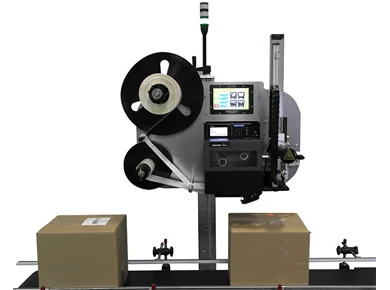
Print and apply machine beside a production conveyor

Cycle-time factors to confirm

Data availabilityHow quickly the authoritative record is available and whether printing can start before the pack reaches the application point.
Label dimensions and contentLonger labels require more media movement; dense graphics, small text and barcode requirements also influence the selected resolution and print settings.
Print and dispense sequenceWhether the label is printed on demand, prepared in advance or held at the peel edge changes how much work remains after product detection.
Applicator travelThe distance to the nearest and furthest pack face, the required dwell and the safe return path affect mechanical cycle time.
Pack movementContinuous wipe, controlled indexing and full conveyor stops create different timing and spacing requirements.
InspectionPresence sensing, decoding, expected-data comparison and formal verification require different exposure and decision windows.
Multiple applicationsTwo-face, three-face or repeated labels add motion, pack handling and recovery logic.

How to prove throughput with representative conditions

1. Define the complete format range

Use minimum and maximum pack dimensions, the longest normal label, the furthest application position and any difficult surface or height variation.

2. Define the real product gap

Measure the smallest normal gap created by the upstream line, including acceleration, accumulation and restart conditions rather than a manually spaced demonstration.

3. Test the normal sequence

Run representative data, printing, application and inspection together. Record whether the applicator returns home and is ready before the next product trigger.

4. Test controlled faults

Introduce missing data, media faults, no label present, no-read and restart conditions. Throughput is not reliable if recovery creates unidentified packs or uncontrolled reprints.

Questions buyers ask about speed and output

Is printer speed the same as line speed?

No. Printer speed describes media movement through the print engine. Line speed must also allow for data preparation, label presentation, applicator motion, return, product spacing and any inspection or reject decision.

Does a larger label reduce throughput?

A larger or longer label can increase print and dispense time and may require a larger applicator pad or longer corner-wrap motion. The effect depends on the selected print settings and whether label preparation can overlap with product movement.

Why does application distance matter?

A longer applicator stroke requires more travel and return time and can increase sensitivity to pack-position variation. The furthest normal face should be included in the trial because the nearest test pack can give an unrealistic result.

Can a slow ERP or WMS connection limit output?

Yes, if the line waits for a record after the pack is already at the station. The interface should define when data is requested, how records are queued, the timeout response and how the physical pack remains linked to the correct message.

Does barcode checking slow the machine?

It can add time, especially when the scanner needs a stable view or the decision must occur before release. The impact depends on whether the check is label presence, decoding, expected-data comparison or formal quality verification.

How is multi-side pallet labelling assessed?

Count every required movement: pallet positioning, applicator travel, label application, scanner exposure and any second or third face. The trial should include the largest normal pallet and the full side sequence rather than a single easy face.
Related technical routes

Provide a line video and format matrix

Lancing can review the real product gap, label size, application distance and required inspection before an output target is accepted.

Discuss throughput

Separate faster cycling from fewer interruptions

Faster application does not eliminate a stop caused by label depletion, an unavailable data service or failed pack identification. Before changing the machine cycle, record whether lost output comes from steady-state speed, replenishment or recovery.

The production-continuity guide compares planned stops, buffers and duty/standby stations without assigning an unsupported uptime figure.

Call nowContact us