How should label position and product presentation be specified?
Label position should be defined as a measurable placement window on a repeatably presented pack, with the product guides, sensors and applicator method chosen to hold that relationship.
The label face and the pack position are one engineering decision
A drawing that shows only the label location is incomplete unless it also defines how the pack reaches that location. Side, top, front, rear, corner and pallet-face applications create different requirements for detection, guidance, stopping, clearance and scan access. The placement window should use fixed pack features rather than a vague visual centre.
Where product variation is unavoidable, the machine must either accommodate it, measure it or route it as an exception.
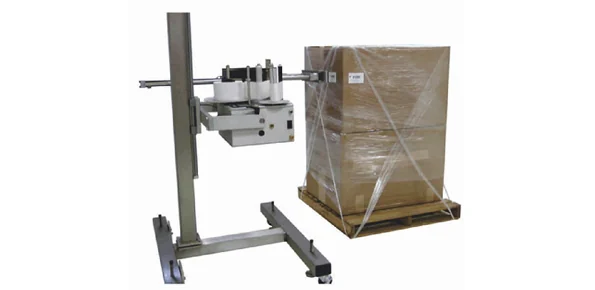
Application-position comparison
| Top | Review pack height variation, top-surface flatness, conveyor support and overhead access. |
|---|---|
| Side | Control lateral position, skew, label-face flatness and side-guide contact. |
| Front or rear | Define product stopping or synchronised motion and clearance for the applicator approach. |
| Corner wrap | Define both face windows, corner condition, label length and the transition path around the edge. |
| Pallet face | Allow for skew, wrap, load overhang, pallet height and multi-face access. |
A five-step presentation review
Choose the scan and viewing face
Start with where the label must be readable in the downstream process.
Define the placement window
Record allowable vertical, horizontal and rotational variation from fixed pack references.
Measure pack variation
Include skew, height, bow, seam, corner damage and conveyor wander.
Select guidance and motion
Decide whether the pack can remain moving or must be stabilised or indexed.
Prove the finished label
Check placement, adhesion and barcode access after normal downstream handling.
Evidence to send with an enquiry
- Dimensioned pack drawing and minimum/maximum formats.
- Photographs of the required label face and nearby obstructions.
- Line video showing product approach, spacing, skew and stopping.
- Label drawing with a measurable placement window.
- Scanner or customer-facing orientation after downstream handling.
Questions answered on this page
Each answer is written to remain clear when read on its own and to show the variables that must be confirmed for a real production line.
Which label face gives the best scan access?
The best face is the one that remains visible and correctly oriented at the real downstream scan point. That may differ from the easiest face to reach at the labeller. Review pallet or carton orientation after wrapping, turning, stacking and transport before fixing the application position.
How close must the pack be to the applicator?
The distance must stay within the selected applicator motion while allowing safe clearance for the worst pack position. Excess distance can increase travel and cycle time, while too little clearance increases contact risk. The machine layout should use the worst-case product envelope and guarding, not only a nominal drawing.
What happens when cartons arrive skewed?
Skew moves and rotates the intended label face relative to the applicator. A label may still adhere but fall outside the placement window or scanner view. Side guides, controlled stopping, product straightening or a larger allowable window may be needed, depending on the pack and line.
Should the product be stopped, guided or stabilised?
Use the least intervention that still produces repeatable presentation. Stable moving cartons may suit wipe application, while flexible, skewed or precise front-face applications may need guidance or indexing. The choice must also preserve product order and the required throughput.
How is a corner-wrap placement window defined?
Define the allowed position on both faces and the permitted relationship to the corner. The label length, split across the faces, barcode location, corner radius and wipe path must all be included. A good result on one face cannot compensate for a barcode distorted around the edge.
What line video and drawings are useful for placement review?
Provide side and overhead video of normal production, a dimensioned pack drawing, conveyor height, required label face and nearby machinery. Show the minimum product gap, stopping behaviour, worst skew and operator access. A still photograph alone rarely shows the movement that determines placement repeatability.
Related print and apply resources
Continue with the page that owns the next decision in the project.
Define the placement window in measurable terms
Send the label drawing, pack range, required face, scanner orientation and production-line video so position and presentation can be assessed together.