What products can print and apply labellers handle?
Print and apply labellers can handle many cartons, cases, pallets, totes and stable products when the label surface, product presentation, adhesive and application method are proved with representative samples.
Suitability is determined by the finished pack at the application point
A product is suitable when the machine can find a repeatable label face, present the correct label and make reliable contact or controlled non-contact application. The catalogue description of the product is less important than its real condition on the conveyor: dimensions, stiffness, orientation, surface energy, contamination, temperature, moisture, seams, curves, wrap and movement all affect the result.
The assessment should include normal variation and foreseeable poor-but-acceptable packs. A perfect empty carton does not prove a full, bowed or cold production pack.
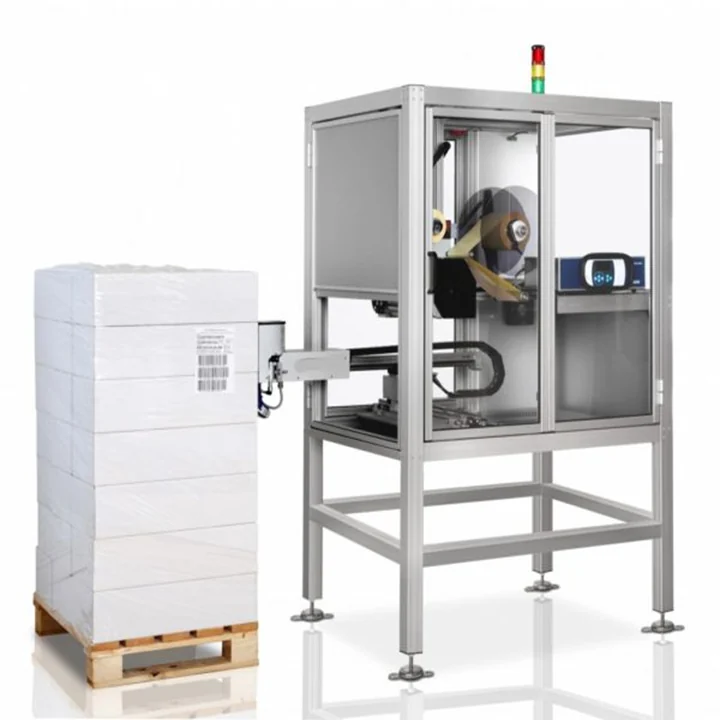
Pack-suitability review
| Surface | Flat or curved, smooth or textured, clean or dusty, dry or affected by condensation, exposed board or film. |
|---|---|
| Stability | Rigid enough for contact, guided against skew, supported during a wipe and not collapsing under application force. |
| Orientation | Label face consistently presented with a known leading edge, height and travel direction. |
| Variation | Minimum and maximum dimensions, bulging, overhang, old labels, seams, wrap tails and damaged corners. |
| Label system | Face stock, adhesive, liner, roll construction, print method and required life matched to the pack condition. |
| Downstream handling | Scanners, rubbing, stacking, wrapping, cold storage, transport and final read position. |
A practical sample set
Minimum and maximum formats
Include the smallest, largest, lowest and tallest pack that the same setup must handle.
Worst normal surface
Include condensation, dust, texture, wrap, seams or recycled-board variation where these occur in production.
Real production label
Use the intended adhesive, face stock, liner, artwork and data extremes rather than a generic demonstration label.
When an alternative route may be better
If the pack cannot present a stable surface, the project may need product guidance, a dedicated nest, a different label face, pre-application to an upstream component, a non-contact method or a manual exception route. The aim is not to force every pack through the same applicator; it is to define which normal variants can be automated and how exceptions remain controlled.
Questions answered on this page
Each answer is written to remain clear when read on its own and to show the variables that must be confirmed for a real production line.
Can a print-and-apply labeller handle cartons with different heights?
It may handle a verified height range when the label face, detection and applicator motion remain within the machine setup. The review should include whether height changes require recipes, guides, sensor movement or mechanical adjustment and whether the greatest travel still fits the required cycle time.
Can labels be applied to shrink film or stretch wrap?
Labels can be applied to film when the actual film surface, tension, temperature, wrinkles and adhesive are compatible. The label should be tested after representative handling because film can move, relax or trap air. The scanner view and downstream rubbing should also be included.
Are curved or soft packs suitable for print and apply?
They can be more difficult because the surface moves away from the applicator or deforms under contact. Suitability depends on label size, curvature, support, application method and placement tolerance. A smaller label, different face, controlled nest or another labelling technology may be more reliable.
Can reusable containers be labelled without permanent residue?
That depends on the approved label and removal process, not on the applicator alone. The project should define whether the label is permanent, removable, wash-off or applied to a dedicated label area. Used totes with old adhesive, scratches and contamination should be part of the trial.
How do dust, condensation and cold surfaces affect suitability?
They can reduce adhesive contact, contaminate sensors and change the behaviour of label materials. The trial should reproduce the real surface temperature and exposure. Cleaning or drying may be valid only when it is an approved, repeatable production step.
What samples should be supplied to prove pack compatibility?
Supply the full size range, worst normal surface, actual filled or loaded condition, final label stock and any wrap or downstream packaging. Include examples that lean, bow, flex or carry seams because those samples reveal the difference between nominal dimensions and real presentation.
Related print and apply resources
Continue with the page that owns the next decision in the project.
Send representative packs, not only dimensions
Provide the minimum and maximum packs, worst surface condition, actual label stock and a line video so suitability can be proved against production variation.