What do print and apply labelling terms mean?
Use these definitions to compare quotations, write acceptance criteria and discuss print engines, applicators, data and verification without relying on ambiguous shorthand.
Print-and-apply terminology describes different parts of one controlled process
Terms such as print engine, tamp, verification and SSCC refer to different physical or data-control functions. Using them precisely makes quotations and fault reports easier to compare. A barcode read is not the same as verification; application cycle is not the same as printer speed; and a placement window is more precise than a general label position.
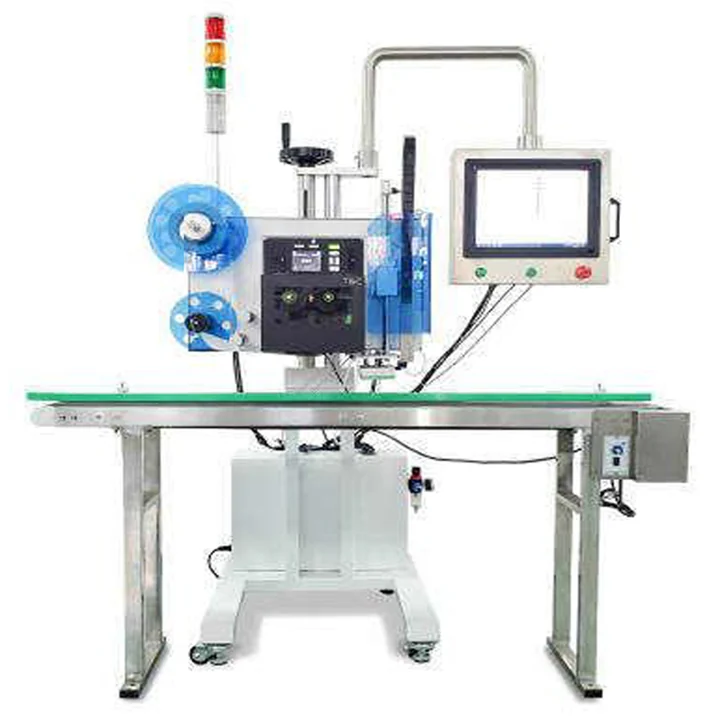
Common print and apply terms
These are general definitions. The delivered machine documentation should define how each term applies to the selected configuration.
Print engine
The industrial printer module that advances label media and creates variable text, graphics or barcode content before application.
Direct thermal
A print method in which heat activates a coated label surface without a ribbon.
Thermal transfer
A print method in which a heated printhead transfers an image from a ribbon to compatible label material.
Peel edge
The point where the backing liner changes direction so the printed label separates and can be received by the applicator.
Tamp pad
The surface that holds a dispensed label and moves it towards the pack for controlled application.
Wipe application
A method that uses relative movement between the pack and the label to press the label progressively onto the surface.
Corner wrap
Application of one label across two adjacent faces of a case, carton or other suitable pack.
Application cycle
The complete sequence from a valid trigger through printing, label presentation, application, confirmation and return to ready.
Placement window
The permitted horizontal, vertical and rotational area in which the finished label must lie.
Expected-data comparison
A control that compares decoded label data with the record expected for the identified pack.
Barcode read
Successful decoding of a symbol; it does not by itself prove formal symbol quality or correct placement.
Barcode verification
A defined assessment of barcode quality under a stated method; it is different from a simple successful read.
Reprint lock
A control that restricts or records reprinting so duplicate valid-looking labels are not created without resolving the original pack state.
SSCC
Serial Shipping Container Code, a GS1 identification key used to identify a logistic unit such as a pallet or grouped shipping unit.
Logistic unit
An item of any composition established for transport or storage that needs to be managed through the supply chain.
HMI
Human-machine interface: the operator screen used for status, recipes, alarms, diagnostics and authorised actions.
I/O
Input/output signals exchanged between the labeller, sensors, conveyor, PLC or other equipment.
Questions about commonly misunderstood terms
What is a print engine?
A print engine is the industrial printer module inside a printer-applicator. It controls the media path and creates the variable image before the label is presented to the applicator. Print method, resolution, label range, ribbon where used, communications and maintenance access all belong to the selected engine configuration.
What is a tamp pad?
A tamp pad holds the dispensed label and moves it towards the pack. Pad size, vacuum or label-holding method, travel, contact surface and release timing must suit the label and placement window. A pad is part of the application system, not a universal component for every label size.
What is a peel edge?
A peel edge is the point where the liner turns sharply and the label separates from it. Label gap, liner stiffness, web tension, sensor calibration and adhesive behaviour affect reliable dispensing at this point. Poor presentation here can appear later as a pick-up or placement fault.
What is an application cycle?
An application cycle is the complete sequence required to accept one valid pack and return ready for the next. It can include data selection, printing, dispensing, applicator movement, label confirmation, scanning and fault checks. It is broader than printer speed or the outward motion alone.
What is expected-data comparison?
Expected-data comparison checks whether decoded label content matches the record assigned to that pack. It can detect a readable but wrong barcode, which a basic no-read check cannot. The project must define the expected source, comparison fields and response to mismatch.
What is a reprint lock?
A reprint lock is a control that prevents unrestricted creation of another label for the same logical record. It may require an authorised action, reason code, destroyed-label confirmation or pack state. Its purpose is to keep recovery traceable and reduce duplicate labels.
What is a placement window?
A placement window is the measurable area and rotation tolerance allowed for the finished label. It should be tied to fixed pack features and downstream scan requirements. “Central” or “near the top” is not sufficiently precise for machine acceptance.
What is a logistic unit?
A logistic unit is a physical unit established for transport or storage, such as a pallet or grouped shipping unit. GS1 uses the SSCC to identify a logistic unit. See the official GS1 SSCC overview for the identification-key definition.
Related resources
Use the glossary with the guide that owns the practical decision.
Use the same definitions in the project brief
Send the label, pack, control requirement and any customer terminology so the quotation can state exactly what is included.