When direct thermal can fit
Consider it for controlled-life labels where the substrate remains stable through the full journey and the process benefits from fewer consumables. Use representative storage and transport conditions during the trial.
Choose the print method by label life, exposure, media and production evidence—not by printer specification alone.
Direct thermal and thermal transfer are both established methods for producing variable-data labels. Direct thermal uses heat-sensitive media and does not require a ribbon. Thermal transfer uses a heated ribbon to place the image on the label. The correct route depends on how long the label must remain readable, what it will be exposed to and which label material is approved.
For a concise explanation of the two print mechanisms, see Zebra’s direct thermal and thermal transfer overview.
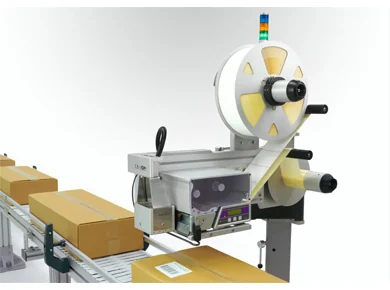
Use this as a project discussion tool; final suitability must be proven with the approved media and real handling conditions.
| Consumables | Direct thermal uses heat-sensitive label media without a ribbon. Thermal transfer uses a ribbon and a compatible receiving surface. |
|---|---|
| Required life | Shorter controlled-life labels may suit direct thermal. Longer-life or more exposed labels often justify a thermal-transfer trial. |
| Exposure | Review light, heat, abrasion, moisture, chemicals, cleaning and contact with packaging materials rather than relying on a generic durability claim. |
| Media choice | Confirm face stock, adhesive, liner, ribbon where applicable, roll construction and whether the combination runs consistently through the selected print engine and applicator. |
| Changeover | Thermal transfer adds ribbon loading and matching. Direct thermal removes the ribbon but still requires controlled media, printhead condition and settings. |
| Acceptance | Approve the printed label immediately after production and after representative ageing, handling and scanning. |
Consider it for controlled-life labels where the substrate remains stable through the full journey and the process benefits from fewer consumables. Use representative storage and transport conditions during the trial.
Consider it where label life, abrasion, handling or media choice demands more than the direct-thermal combination can prove. Ribbon grade, label surface and print energy must be assessed together.
If the pack surface, adhesive or scanner geometry is uncertain, the print-method decision is only one part of the trial. A good print cannot compensate for poor application or unsuitable label stock.
Prove the selected method with the same data, consumables and handling conditions expected in production.
Test smallest text, densest barcode, longest data strings and any graphics at the selected resolution.
Check print registration, label presentation, ribbon behaviour where used, peel performance and applicator pick-up.
Include minimum and maximum pack variation, real line speed, product gap and the intended label position.
Retest after storage, transport simulation or environmental exposure relevant to the customer process.
Use these answers to prepare a print-method trial.
Direct thermal media forms the image when the printhead heats a coated label. Thermal transfer uses a ribbon to transfer the image to the label. The right choice depends on required life, exposure, media and the approved artwork.
It can be suitable where the label is used for a controlled, relatively short journey and the approved media remains readable for the required period. The real label should be tested against handling, heat, light and abrasion.
Thermal transfer is normally considered where the label needs greater durability, a wider media choice or resistance to handling and environmental exposure. Ribbon and label stock must be qualified together.
The physical applicator can be similar, but consumables, ribbon handling, print settings, maintenance and the evidence needed at trial are different.
They should be developed together. Artwork, barcode density, label material, print resolution and method can affect the printed result, so approval should use the intended production combination.
Use the comparison with the label-size, thermal-transfer and acceptance pages so the selected print method is proved with the actual artwork and production route.
Send the required label life, exposure, proposed media, artwork and representative handling conditions for a print-method review.
Lancing can review the artwork, media, print method, label position and application sequence together before the machine scope is fixed.